ANW Dove Learning & Communication, established 2011 Let’s Connect
Menu
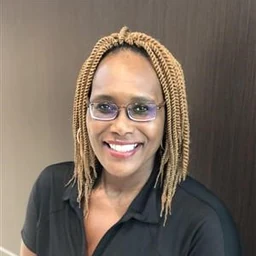
Portrait of Antoinette Norris Woodson

Articulate 360 License Holder | Instructional Designer | AI Integration & User Experience Design

Which Gap Can I Fill for You?

Scenario simulations, assessments built to psychometric standards, and governance for artificial intelligence (AI) agents. Built for financial services, healthcare, and other regulated workforces.

Gaps Filled

Business Solutions

Pediatric Triage Micro-Scenario

Capability demonstration, healthcare sector
A nurse in a white coat and navy scrubs carries a clipboard toward the viewer down a bright hospital hallway
Business Problem
Early-career pediatric nurses and nurse practitioners new to emergency department triage tend to default to familiar workflows, such as history-taking, escalation, and medication, over the single most critical action. In a febrile infant under 90 days, the correct first action, full vital signs and monitoring, is frequently delayed in favor of more habitual steps.
Business Solution
A branching micro-scenario built with the 4C method (Characters, Context, Challenge, Consequences) at micro-scale: one case, one decision point, four response paths. Each incorrect choice maps to a named reasoning error, distraction, overtriage, or delay, and returns the learner to reselect with layered feedback. Answer choices unlock only after the narration finishes. Built in Articulate Storyline 360, with a design document and storyboard.
Business Impact
Built as a capability demonstration for a prospective healthcare client. A signed contract was the result.

Assessment Items and Standards

Contract work, Ascend Learning
A B C key D
Business Problem
An item has to measure the skill it claims to measure, and its wrong answers have to do their job.
Business Solution
More than 125 Test of Essential Academic Skills (TEAS) items authored to psychometric standards, with p-value and distractor analysis, plus construction and revision of the TEAS assessment standards.
Business Impact
Most recommendations on the TEAS assessment standards were accepted. The revised standards are in effect in 2026.
Review Panels
Appointed to Texas Education Agency (TEA) standards and item review committees and to the TEA and Pearson educator certification examination committee for Mathematics. Texas Mathematics Advisory Board Member for Glencoe Mathematics (McGraw-Hill/Glencoe), Grades 6 through Algebra 2: reviewed content prototypes and chapters for the Texas statewide adoption. My likeness appears in the published Texas textbooks.

Financial Needs Discovery Simulator

Self-initiated build
Client Representative
Business Problem
New insurance agents were failing to build relationships with clients. They lost potential clients and didn't grow into business partners, because they didn't connect with clients on a personal level or respond in a way that built the client's confidence in the agent's ability and knowledge to meet their needs.
Business Solution
A real-time practice simulation on devlin.ai. The learner conducts a discovery conversation with a skeptical, variable-income client, and the meaningful financial risk comes out only after the learner asks relevant, context-driven questions about work structure and income variability. Agents practice thinking on their feet, answering questions as they arise, and using customer service etiquette before a real prospect is in the room. Also packaged in Articulate Storyline.
Business Impact
Mistakes in customer interactions get worked out before they go live.

Dove 3R Assessment Design

Original model, authoring-tool agnostic
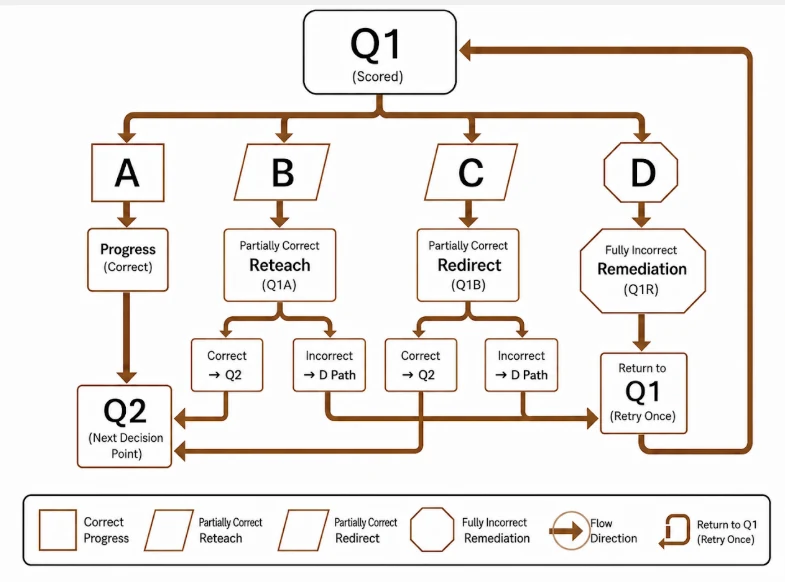
Flowchart of a scored question: option A progresses to the next decision point, options B and C are partially correct and route to reteach and redirect paths, and option D is fully incorrect and routes to remediation, then returns to the question for one retry
Business Problem
A scored question that reports only right or wrong cannot tell a knowledge gap from a misconception.
Business Solution
A branching decision flow that diagnoses learner understanding and routes instruction by response accuracy: progress, reteach, redirect, or remediation. The four-path split aligns the instructional response to the precision of what the learner actually demonstrated. Fully incorrect answers route to remediation and return to the question for one retry. The logic is authoring-tool agnostic and has been applied in Articulate Storyline.
Business Impact
A missed question now reports what kind of miss it was, so reteaching targets the misconception and not only the wrong answer.
Research Basis
Ten peer-reviewed sources on corrective feedback, mastery learning, and conceptual change support routing by response accuracy.
Read the 10 references

Bloom, B. S. (1968). Learning for mastery. Evaluation Comment, 1(2), 1-12.

Bloom, B. S. (1984). The 2 sigma problem: The search for methods of group instruction as effective as one-to-one tutoring. Educational Researcher, 13(6), 4-16. https://doi.org/10.3102/0013189X013006004

Brown, J. S., & VanLehn, K. (1980). Repair theory: A generative theory of bugs in procedural skills. Cognitive Science, 4(4), 379-426.

Guskey, T. R., & Pigott, T. D. (1988). Research on group-based mastery learning programs: A meta-analysis. Journal of Educational Research, 81(4), 197-216.

Hattie, J., & Timperley, H. (2007). The power of feedback. Review of Educational Research, 77(1), 81-112. https://doi.org/10.3102/003465430298487

Pacaci, C., Ustun, U., & Ozdemir, O. F. (2024). Effectiveness of conceptual change strategies in science education: A meta-analysis. Journal of Research in Science Teaching, 61(6), 1263-1325. https://doi.org/10.1002/tea.21887

Posner, G. J., Strike, K. A., Hewson, P. W., & Gertzog, W. A. (1982). Accommodation of a scientific conception: Toward a theory of conceptual change. Science Education, 66(2), 211-227. https://doi.org/10.1002/sce.3730660207

Shute, V. J. (2008). Focus on formative feedback. Review of Educational Research, 78(1), 153-189. https://doi.org/10.3102/0034654307313795

Van der Kleij, F. M., Feskens, R. C. W., & Eggen, T. J. H. M. (2015). Effects of feedback in a computer-based learning environment on students' learning outcomes: A meta-analysis. Review of Educational Research, 85(4), 475-511. https://doi.org/10.3102/0034654314564881

VanLehn, K. (1990). Mind bugs: The origins of procedural misconceptions. MIT Press.

Bring the Performance Problem.

The first call covers what to build and in what order.

  • EngagementIndependent contractor. Paid directly as 1099, or B2B through Dove Learning & Communication.
  • Based InGreater Houston / Sugar Land, Texas
  • CredentialsArticulate 360 License Holder. Texas Life and Health Insurance License. Applied Instructional Design Academy Instructional Design Certificate. Secondary Mathematics Certification: Texas, South Carolina, West Virginia, Tennessee.